Do you know how prepared residents are for an emergency?
With SamenParaat, you share a short resident check through your own channels. You see where participating households are still missing preparations and receive concrete suggestions for follow-up communication. Your municipality sees totals only.
- The municipality never sees individual answers
- Hosted in the EU, no tracking cookies
Fictitious data · no account needed
Start a free 30-day trial · no payment details, stops automatically
22% have a battery-powered radio
Possible follow-up action: explain the emergency radio station through the municipal paper and social media.
How it works
- 1
You share your own QR code
You get your own QR code, link and A4 poster and share them through your own channels: local paper, municipal website, social media, front desk and local partners.
- 2
Residents take the check
A short check of a few minutes based on the Denk vooruit advice. Residents then get a free app with their shopping list, emergency plan and tips.
Take the resident check → - 3
You see where it falls short
The dashboard shows results by topic, by district and by age group, with recommended actions for your communication.
- 4
You measure again
After a campaign you start a new round with the same QR code. Returning residents only change what has changed.
What you do, and what we take care of
The municipality
- Share the QR code through your own channels and local partners.
- Agree distribution with communications, and with privacy and procurement where needed.
- Use the results in your communication and consultations.
SamenParaat
- The resident check and the free Mijn NoodCheck app, in Dutch and English.
- Your own QR code, link and A4 poster, with your logo.
- Dashboard, recommended actions and quarterly report.
- Automatic district mapping based on CBS data; your own mapping is possible too.
- Hosting and storage in the EU, and support by email.
From result to municipal action
Figures only matter when they lead to a decision. This is what that looks like in practice:
| Signal in the dashboard | Possible next step |
|---|---|
| Household emergency plans lag behind | Distribute an ‘our emergency plan’ card through schools and community centres |
| Response lags in one district | Adjust distribution through local partners such as the GP, library or neighbourhood team |
| Younger participants score lower on cash | A social media post on why card payments fail during a power cut |
Every recommended action in the dashboard comes with ready-made texts for the local paper, website and social media.
See where preparation falls short, and track what changes.
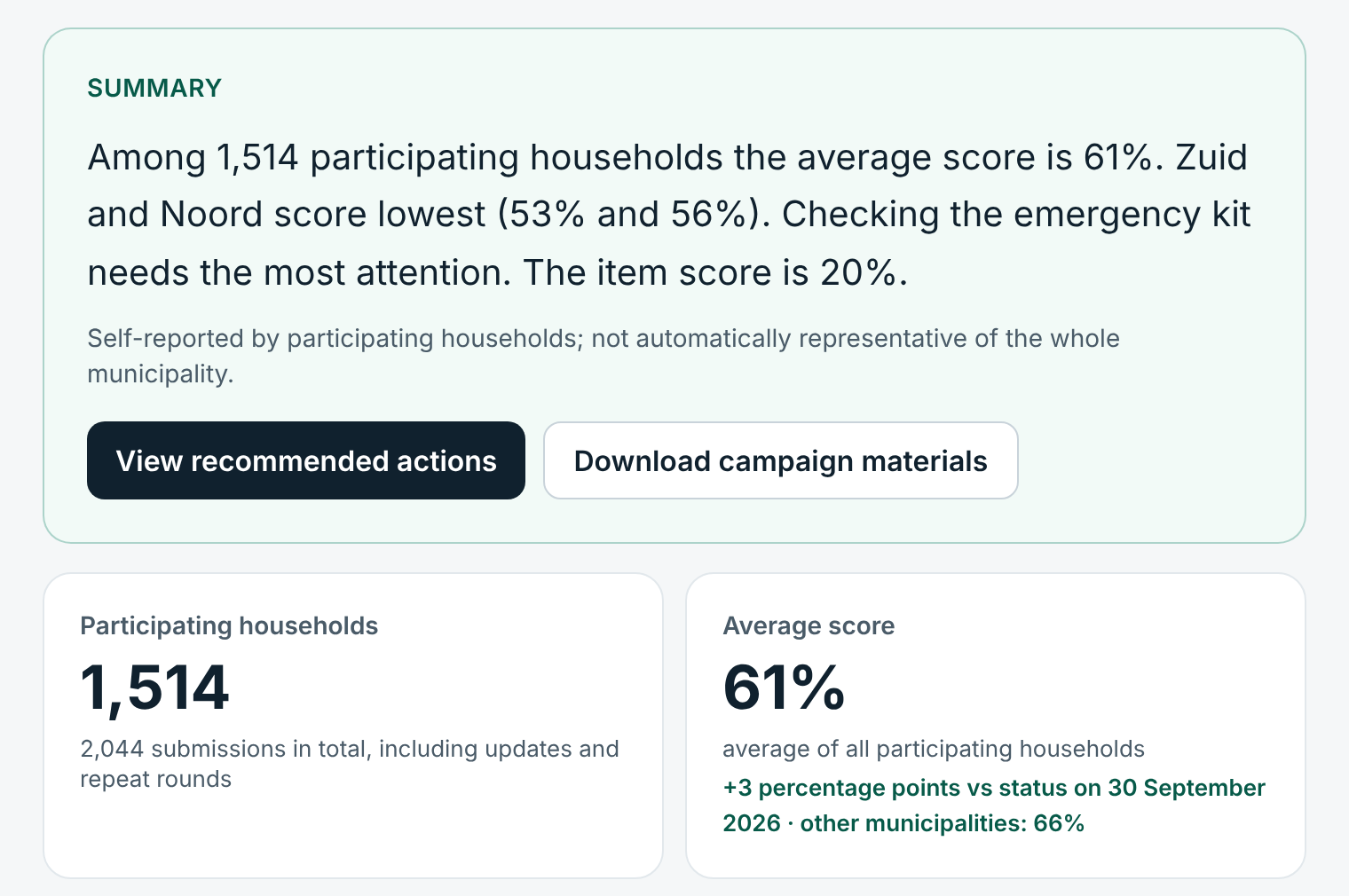
The dashboard is built for alignment with communications, council briefings and consultation with the safety region. At a glance you see how participating households are doing and which topics may need extra attention.
- Summary and recommended actions: topics that may need extra attention, with ready-made texts.
- Round after round: compare a new measurement with the previous one, including for the same households.
- Quarterly report: a report every quarter to share or print.
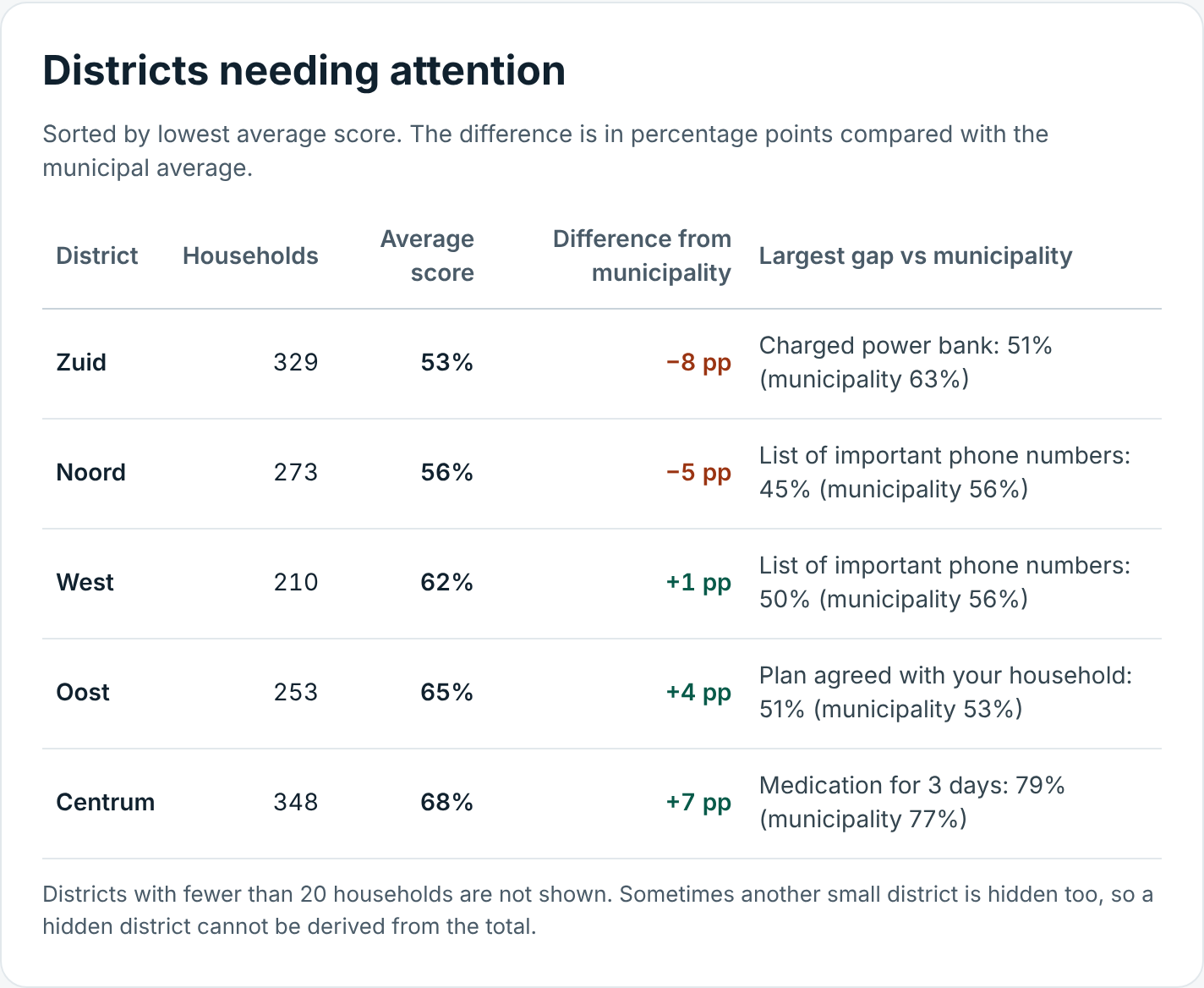
See by district where to start.
Districts are ordered by lowest score, each with the topic that lags furthest behind. This helps you choose where a neighbourhood activity, flyer or talk with the community officer may be appropriate.
- By district and age group: groups with fewer than 20 households are not shown, nor anything from which they could be worked out.
- Comparison with other municipalities: anonymous, and only when enough municipalities take part.
Privacy, limitations and reliability
Residents trust you with their home situation. That is why the municipality never sees who answered what, and why we are clear about what the figures do and do not show.
What we ask
- The four digits of the postcode, for the district breakdown
- The number of adults and children at home
- The answers to 16 questions about emergency kit and plan
- Optional: age group
- Optional: email address, kept apart from the answers, only to save the list or send a reminder
What we do not ask or store
- Name, address or phone number
- IP addresses (only an irreversible code against abuse)
- Answers per person for the municipality: you only see totals
How to read the results
Taking part is voluntary. The figures show how participating households are doing, not the whole municipality. People who take part may differ from those who do not. So also look at response by district and age group. A change between two measurements shows what changed, but does not by itself prove that your campaign caused it.
Transparent pricing, by municipality size
One product with the same features for every municipality. The price follows the population according to Statistics Netherlands (CBS).
What is included
- Your own QR code, link and poster with logo
- Resident check and app in Dutch and English
- Dashboard by topic, district and age group
- Recommended actions with ready-made texts
- Repeat measurements with before/after comparison
- Reminders for residents for a new round
- Quarterly report
- Export of totals (CSV)
- Unlimited users
- Set-up and support by email
| SmallUp to 25,000 residents | €499 per month | €4,990 per year |
|---|---|---|
| Medium25,000 to 100,000 residents | €749 per month | €7,490 per year |
| LargeOver 100,000 residents | €1,195 per month | €11,950 per year |
All amounts exclude VAT. Annual subscription = 2 months off.
How to use the trial
The trial is intended to let you independently assess how it works and whether it is suitable.
- You receive
- Your own environment, resident link, QR code and poster.
- You organise
- Distribution through your own municipal channels.
- You assess
- The resident experience, the dashboard and, with sufficient participation, the first results.
- Afterwards
- The trial stops automatically. You only pay after activating a subscription yourself.
Breakdowns by district and age group only become visible from 20 unique households and only when totals cannot be traced back to a smaller group.
Prefer to talk first? Book a 20-minute call
An annual subscription remains well below the usual thresholds for a multiple-supplier negotiated procedure. Check this against your own procurement policy.
Working with other municipalities in your safety region? Contact us about the options.
Become a pilot municipality
The pilot lasts 3 months and is intended to run a local campaign and evaluate the results together. The first 3 municipalities receive the pilot free of charge. Then 50% off the first subscription year; from year 2 the regular rate applies.
Start as a pilot municipalityIn return, we ask
- We may name your municipality as a pilot municipality.
- We schedule a 30-minute evaluation after the pilot.
- If you are satisfied, we ask for a short quote. A quote is not required.
How the pilot runs
The municipality organises distribution itself. SamenParaat provides the environment, materials and overview.
Month 1 · prepare
Municipality: Provides the logo, checks the resident link and agrees distribution with communications and local partners.
SamenParaat: Prepares the environment, QR code and poster, and provides distribution materials.
Month 2 · invite residents
Municipality: Shares the QR code through the selected channels.
SamenParaat: Processes the check and shows response in the dashboard.
Month 3 · discuss the results
Municipality: Discusses the signals and chooses possible follow-up actions.
SamenParaat: Provides aggregated results and recommended actions; then we evaluate together in 30 minutes.
Everything for internal review
Documents for your manager, privacy officer and procurement adviser. We send the terms and conditions and the data processing agreement on request.
Frequently asked questions
Is this the same as Denk vooruit?
No. Denk vooruit is the national government campaign. SamenParaat is an independent service that uses the public advice of that campaign, so you can measure and adjust locally.
What happens after the trial?
The trial stops by itself after 30 days (3 months for pilot municipalities). You get a reminder a week before. To continue, you activate the subscription in the portal and choose term and payment method there. If you do nothing, the dashboard and questionnaire pause. Nothing is ever charged automatically.
Are the figures representative of our municipality?
Not automatically. Taking part is voluntary, so you see how participating households are doing. That is why the dashboard also shows response by district and age group, so you see where to reach more people.
What do we need to organise ourselves?
Mainly distribution: the QR code in your paper, on your website, on social media and through local partners. Nothing needs to be installed.
What does it cost residents?
Nothing. Residents use the check and the Mijn NoodCheck app for free, with or without an account. The municipality pays the subscription.
Do we need a tender?
An annual subscription remains well below the usual thresholds for a multiple-supplier negotiated procedure. Check this against your own procurement policy.
Can we pay by invoice?
Yes. Choose ‘by invoice’ when activating and enter your purchase order number. You receive an invoice with 30-day payment terms.
See for yourself.
View the dashboard and the resident check with fictitious data. A good fit? Then start a trial environment for your own municipality.
30 days · no payment details · stops automatically
Want to talk first?
Maarten Roelofs · Initiator of SamenParaat · info@samenparaat.nl
Maarten is building SamenParaat to give municipalities a practical local follow-up to Denk vooruit, without making residents’ individual answers visible. SamenParaat is a service of Infiliate B.V., Chamber of Commerce 99308770, Lelystad.